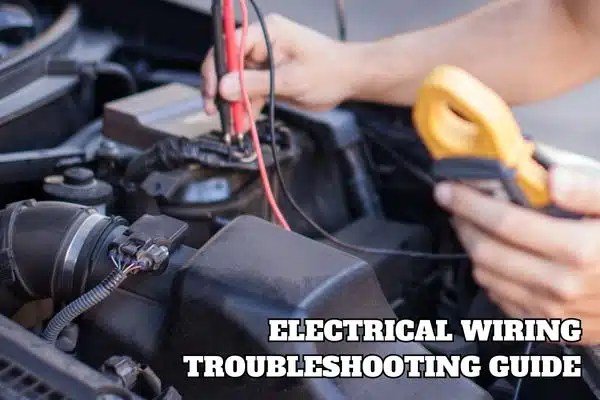
Your car’s electrical system can feel like a tangled web of mystery, especially when something goes wrong. A dead headlight, a window that won't roll down, or worse, a car that refuses to start – these are the moments when the unseen forces of volts, amps, and ohms loom large. But imagine having a blueprint, a precise map that guides you through every wire and component. That's exactly what you get with Automotive Electrical Troubleshooting with Diagrams, transforming guesswork into confident diagnosis and effective vehicle repairs.
It's not about being an auto electrician; it's about adopting a methodical approach and leveraging the invaluable resource of wiring diagrams to understand, diagnose, and fix common electrical problems. Forget endless trial-and-error; with the right tools and knowledge, you can pinpoint issues with impressive accuracy.
At a Glance: Becoming Your Own Electrical Detective
- Electrical issues are common but often intimidating. Don't let complexity deter you.
- Wiring diagrams are your ultimate roadmap. They demystify circuits, showing connections and component locations.
- A systematic approach is key. Randomly poking wires is inefficient and risky.
- Essential tools are surprisingly few. A good multimeter is your best friend.
- Safety always comes first. Never work on a live circuit without proper precautions.
- You can do this! With practice, troubleshooting becomes much clearer.
Decoding Your Vehicle's Nervous System
Before we dive into the diagrams, let's briefly grasp the fundamentals. Your car is an intricate network of electrical pathways, all working in harmony. At its core, it relies on three basic principles:
- Voltage (Volts, V): Think of this as electrical pressure or the "push" that gets electricity moving. Your car typically operates on a 12-volt system (when off) to about 14.5 volts (when running and charging).
- Current (Amperes, Amps, A): This is the actual flow rate of electricity, like the volume of water flowing through a pipe. Too much current can blow a fuse or damage components.
- Resistance (Ohms, Ω): This is the opposition to current flow. Every component has resistance, but excessive resistance (like corrosion on a terminal) restricts current and causes problems.
These three are intertwined by Ohm's Law (V=IR), a fundamental concept that helps technicians understand circuit behavior. Your vehicle contains various electrical systems: - Starting System: Gets the engine turning.
- Charging System: Keeps the battery topped up and powers electrical components while driving.
- Ignition System: Creates the spark to ignite fuel.
- Lighting System: Headlights, taillights, interior lights.
- Accessory Systems: Power windows, wipers, radio, HVAC, power seats, etc.
- Computer Control Systems (ECU/PCM): Manage engine functions, emissions, and often communicate with many other modules.
When any part of this complex "nervous system" malfunctions, it's usually due to a break in the circuit (an open), an unintended path for electricity (a short), too much resistance, or a faulty component. This is where your wiring diagrams become indispensable.
The Indispensable Map: Unlocking Wiring Diagrams
Think of a wiring diagram as the precise blueprint for your car's electrical system. It's not just a jumble of lines; it's a meticulously organized schematic that shows you where every wire goes, what color it is, what components it connects, and how electricity flows through the circuit. Without it, you're guessing in the dark; with it, you have a clear path forward.
What You'll Find on a Diagram:
- Wires: Represented by lines, often color-coded with abbreviations (e.g., "RD" for red, "BL/WH" for blue with a white stripe).
- Fuses: Square or rectangular symbols, often with a number indicating their amperage rating. They protect circuits from overcurrent.
- Relays: Usually depicted as a switch with a coil, relays use a small electrical current to control a larger one.
- Switches: Various symbols depending on their type (push-button, toggle, rotary, etc.), showing their open and closed states.
- Lights: A circle with a cross inside.
- Motors: A circle with an "M" inside.
- Sensors: Diverse symbols, often with labels indicating what they measure (e.g., "ECT" for Engine Coolant Temperature).
- Control Modules (ECU, BCM, PCM): Represented by blocks, often with pinout numbers that correspond to connectors.
- Grounds: A symbol resembling an inverted pyramid or three horizontal lines of decreasing length, indicating a connection to the vehicle's chassis or battery negative terminal.
- Connectors: Often shown as dashed lines or boxes, with pin numbers.
Reading and Interpreting:
- Understand the Legend: Every diagram should have a legend explaining the symbols and abbreviations used. Don't skip this step!
- Follow the Power Flow: Electricity generally flows from the battery, through fuses, switches, and components, and then to ground. Trace this path on the diagram.
- Identify Components: Locate the component you're troubleshooting and see what wires enter and exit it.
- Note Wire Colors & Pin Numbers: This is crucial for identifying the correct wires when you're under the hood. For instance, if the diagram shows a blue wire with a red stripe going to pin 3 of a connector, that's what you'll look for.
- Look for Splices & Connectors: Diagrams show where wires join or pass through connectors, which are common points of failure due to corrosion or looseness.
Many resources, including online repair manuals and reputable auto parts store websites like AutoZone, provide access to wiring diagrams. They are an invaluable tool for any DIY mechanic. You can Learn more about wire diagrams and how to access them for your specific vehicle.
Essential Tools for the Electrical Detective
You don't need a garage full of specialized equipment to start troubleshooting. A few key tools will cover the vast majority of electrical issues.
- Digital Multimeter (DMM): This is your primary diagnostic tool. A DMM can measure:
- Voltage (V): To check if power is present and at the correct level.
- Resistance (Ω): To check for continuity (a complete circuit) or measure the resistance of components.
- Current (A): (For higher-end DMMs or clamp-on meters) To measure the actual flow of electricity, useful for parasitic drain tests.
- How to use: Set the dial to the desired function (e.g., DC Volts), touch the red probe to the positive test point and the black probe to the negative/ground.
- Test Light: A simpler, less expensive tool that quickly tells you if power (voltage) is present. It consists of a light bulb, a pointed probe, and an alligator clip.
- How to use: Clip the alligator clip to a known good ground (e.g., battery negative terminal). Touch the probe to the wire or terminal you want to test. If the light illuminates, power is present. Be cautious: it only confirms voltage, not necessarily the right voltage or sufficient current flow.
- Jumper Wires: Wires with alligator clips on both ends. Useful for safely bypassing a switch or providing temporary power to a component for testing (e.g., testing a cooling fan motor directly). Always use fused jumper wires to prevent accidental shorts.
- Wire Strippers/Crimpers: For making proper, secure electrical connections if you need to repair or replace wires.
- Circuit Breaker/Fuse Puller: A small plastic tool that makes removing fuses much easier, especially in tight spaces.
- Scan Tool (OBD-II Scanner): While primarily for engine codes, many modern electrical issues are computer-controlled and will trigger Diagnostic Trouble Codes (DTCs). A scan tool can read these codes and provide clues, often pointing you to a specific circuit or component.
- Safety Glasses and Gloves: Always protect your eyes from sparks and your hands from heat or sharp edges.
The Systematic Troubleshooting Approach: Your Electrical GPS
Randomly poking wires is inefficient and can cause more damage. A systematic approach, guided by your wiring diagrams, is crucial.
Step 1: Define the Problem with Precision
Don't just say "my lights aren't working." Be specific:
- Which lights? (Headlights, interior, brake lights?)
- Are all of them out, or just one side/one bulb?
- When did it start? (Suddenly, after a repair, intermittently?)
- Are there any other related symptoms? (e.g., "When the headlights went out, the radio also stopped working.")
- Did you recently work on anything nearby?
Step 2: Research and Gather Information
This is where your wiring diagrams become critical.
- Consult your owner's manual: Check for fuse locations and basic system information.
- Access repair manuals or online resources: Find the specific wiring diagram for the affected circuit. Many auto parts retailers or online services provide vehicle-specific diagrams.
- Look for Technical Service Bulletins (TSBs): Sometimes, a known electrical issue has a manufacturer-issued fix.
Step 3: Visual Inspection – The Easiest Fixes First
Before grabbing your multimeter, a thorough visual inspection can save a lot of time.
- Check Fuses: Locate the fuse box (or boxes, as modern cars often have multiple) using your diagram. Pull and inspect the relevant fuse. A blown fuse will have a broken wire inside. Replace with a fuse of the exact same amperage rating.
- Look for Obvious Damage: Frayed, burnt, or corroded wires. Loose or disconnected connectors. Cracked or damaged components.
- Check Grounds: Many electrical problems stem from poor ground connections. Look for corrosion or loose bolts where ground wires attach to the chassis or engine.
- Inspect Bulbs: A simple bulb check can prevent complex troubleshooting.
Step 4: Verify Power and Ground – The Foundation
Electricity needs a complete path (power in, component, ground out).
- Check for Power (Voltage): Using your multimeter set to DC Volts, touch the red probe to the power wire feeding the component (identified on your diagram) and the black probe to a known good ground (e.g., battery negative terminal or chassis). You should see battery voltage (around 12V with the engine off).
- Check for Ground: Disconnect the component. Use your multimeter in continuity mode (or resistance mode, looking for near 0 ohms) or a test light (connected to battery positive). Touch one probe to the component's ground wire (identified on your diagram) and the other to a known good ground. You should have continuity (the meter beeps or shows very low resistance).
Step 5: Isolate the Circuit – Narrowing Down the Suspects
Using your wiring diagram, trace the path of electricity for the faulty component.
- Identify components in the circuit: Fuse, relay, switch, module, the component itself, and the wiring in between.
- Work backward or forward: If there's no power at the component, trace backward towards the fuse or switch. If there's power but the component isn't working, trace forward to the component itself or its ground.
- Bypass with Jumper Wires (Carefully!): For example, if you suspect a switch is bad, you can sometimes use a fused jumper wire to temporarily bypass the switch to see if the component then works. This confirms the switch is the problem.
Step 6: Test Components & Wires – The Nitty-Gritty
This is where your multimeter shines.
- Voltage Drop Test: This is often more revealing than just checking for voltage presence. A voltage drop test measures how much voltage is lost across a wire or connection.
- Set your DMM to DC Volts. With the circuit active (e.g., headlights on), connect the red probe to one end of a wire/component and the black probe to the other end. Ideally, you want to see very low voltage drop (less than 0.2V for power wires, less than 0.1V for ground wires). High voltage drop indicates excessive resistance (corrosion, loose connection, damaged wire).
- Continuity Test (with Resistance): Disconnect the component from power. Use your DMM's continuity setting (often beeps for continuity) or resistance setting (Ω).
- Check wires: Touch probes to each end of a wire. You should hear a beep or see very low resistance (near 0 ohms). High resistance or no continuity means an open circuit in the wire.
- Check switches: Test continuity in both open and closed positions.
- Check components: Some components have specific resistance values (e.g., certain sensors). Consult your service manual for specs. An "open" circuit in a component often means it's faulty.
- Amperage Test (for parasitic drain): If you have a parasitic draw (something slowly draining your battery while the car is off), you'll need to measure current.
- Disconnect the negative battery cable. Connect your DMM in series between the battery post and the cable (red probe to cable, black probe to battery post). Set your DMM to Amps.
- Wait for modules to "go to sleep" (can take 15-45 minutes). The reading should drop to a very low level (usually under 50 milliamps or 0.050 Amps). If it's higher, start pulling fuses one by one (reconnecting the DMM each time) until the draw drops, indicating the faulty circuit.
Step 7: Interpret Results & Formulate a Plan
- No voltage where there should be? The problem is upstream (fuse, relay, switch, or wiring).
- Voltage present, but component doesn't work? Problem is the component itself or its ground.
- High resistance/open circuit in a wire? Damaged wire.
- Low voltage/high voltage drop? Poor connection, corroded terminal, or undersized wire.
Step 8: Repair and Re-test
Once you've identified the faulty part or connection, make the repair.
- Replace components: Use OEM or high-quality aftermarket parts.
- Repair wiring: Use appropriate connectors, solder, and heat shrink tubing for durable repairs.
- Clean connections: Use a wire brush or sandpaper to remove corrosion from terminals and ground points.
After the repair, re-test the circuit thoroughly to ensure the problem is resolved.
Common Automotive Electrical Headaches (and How Diagrams Help)
Let's look at a few typical scenarios where wiring diagrams are your best friend.
Dead Battery / No Start
Scenario: Your car won't crank, or cranks slowly. The battery is new or recently charged.
Troubleshooting:
- Check Battery Voltage: With the engine off, it should be 12.6V. Cranking, it shouldn't drop below 10V.
- Inspect Terminals: Clean, tight connections are paramount.
- Consult Charging System Diagram: Follow the heavy gauge wires from the battery to the starter motor and alternator. Look for the starter relay.
- Test Starter Solenoid/Motor: Use the diagram to identify the trigger wire to the starter solenoid. Check for voltage on this wire when the key is turned to "start." If voltage is present but the starter doesn't engage, the starter motor/solenoid is likely bad. If no voltage, trace back to the ignition switch or relay.
- Test Alternator: If the battery drains quickly while driving, the alternator might not be charging. The diagram shows how the alternator connects to the battery and the voltage regulator.
Lights Not Working (Headlights, Tail Lights, Interior Lights)
Scenario: A specific light or set of lights is out.
Troubleshooting:
- Check Bulb: Obvious, but often overlooked.
- Check Fuse: Refer to your lighting circuit diagram to find the correct fuse. Many vehicles have separate fuses for left/right, high/low beams.
- Trace Power to Switch: Use the diagram to identify the headlight switch or multi-function switch. Test for power into and out of the switch in different positions.
- Check for Ground: The diagram will show the ground points for the light assembly. Poor grounds are a common cause of dim or non-functional lights.
- Relays: If an entire circuit (e.g., all high beams) is out, check the relay shown on the diagram. You can often swap it with a known good, identical relay from another circuit for a quick test.
Power Windows / Locks Fail
Scenario: A window doesn't go up or down, or power locks don't respond.
Troubleshooting:
- Consult the Accessory Circuit Diagram: This will show the window motor, switch, and any control modules involved (often in the door itself).
- Check Fuse: Many accessory circuits are fused individually.
- Test the Switch: Using the diagram, test for power entering and exiting the switch when pressed. If power goes in but not out, the switch is faulty.
- Test the Motor: If power is reaching the motor but it's not operating, the motor is likely bad. The diagram will show the motor's wiring, often with two wires that reverse polarity to move the window up or down.
- Wiring Harness in Door Jamb: Wires often break in the flexible harness where it passes through the door jamb due to repeated opening and closing. The diagram helps you identify the specific wires to inspect.
Mysteriously Blown Fuses
Scenario: A fuse repeatedly blows immediately or shortly after replacement.
Troubleshooting: This almost always indicates a short circuit to ground.
- Identify the Circuit: The wiring diagram for that fuse's circuit is essential. It will show every component and wire on that circuit.
- Disconnect Components: Start by disconnecting all components on that circuit, then replace the fuse. If it doesn't blow, reconnect components one by one until the fuse blows again. The last component reconnected (or the wiring leading to it) is the culprit.
- Inspect Wiring: Look for pinched, chafed, or melted wires that could be touching the vehicle's metal chassis. This is where the diagram helps you visualize the entire wire run.
Advanced Tips for Tricky Situations
Some electrical issues go beyond simple power and ground checks.
- Intermittent Problems: These are the most frustrating. They often point to loose connections, corroded terminals, or heat-sensitive components. Wiggle tests (gently wiggling wires and connectors while the circuit is active) can sometimes expose these issues. Diagrams help you identify all connection points.
- Parasitic Draws: As mentioned, measuring current drain on the battery while the car is off helps find modules or components that aren't shutting down properly. Your diagram helps you identify which circuits feed which modules.
- Module Communication (CAN Bus): Modern cars use sophisticated data networks (like CAN bus) for modules to communicate. If a module isn't communicating, a scan tool is crucial. The diagram shows the specific CAN wires (often twisted pairs) for diagnostic purposes.
- When to Call a Professional: Don't be afraid to hand it over to a qualified technician if you're stumped, uncomfortable, or if the issue involves complex computer systems that require specialized diagnostic equipment. Knowing when to stop can save you time, money, and further damage.
Avoiding Common Troubleshooting Pitfalls
Even seasoned pros can fall into these traps.
- Ignoring the Diagram: Trying to troubleshoot without a wiring diagram is like trying to navigate a new city without a map. You're just guessing.
- Assuming the Obvious: Just because a fuse "looks" good doesn't mean it is. Always pull and inspect, or better yet, test for continuity.
- Not Checking Power AND Ground: Both are essential for a circuit to work. Don't assume if you have one, the other is fine.
- Guessing vs. Testing: Replacing parts based on a hunch is expensive and often wrong. Test, confirm, then replace.
- Lack of Safety: Always disconnect the negative battery terminal before working on electrical components, especially when replacing components or dealing with high current wires.
- Overlooking Simple Solutions: Always check the battery, battery terminals, and basic connections first. The most complex problem can sometimes have the simplest cause.
Keeping Your Car's Electrical System Healthy
A little preventative maintenance can save you a lot of headache.
- Regular Battery Checks: Test your battery's voltage and health regularly.
- Clean Terminals: Keep battery terminals and ground points free of corrosion.
- Secure Wiring: Ensure all wiring harnesses are properly clipped and not rubbing against sharp edges or hot components.
- Proper Fuse Replacement: Always replace blown fuses with one of the exact same amperage rating. Using a higher-rated fuse can cause serious wiring damage or fire.
- Inspect Connectors: During other maintenance tasks, take a moment to inspect electrical connectors for corrosion or looseness.
Demystifying Electrical Terminology: A Quick Glossary
- Amperage (Amps): The rate of electrical current flow.
- Circuit: A complete path for electricity to flow from a power source, through a component, and back to ground.
- Continuity: A continuous, unbroken path for electricity. Checked with a multimeter.
- Ground: The return path for electrical current, typically to the negative battery terminal or vehicle chassis.
- Open Circuit: A break in a circuit, preventing current flow (e.g., a broken wire, a blown fuse, a bad switch).
- Parasitic Draw: An electrical drain on the battery when the vehicle is off, caused by components that don't shut down completely.
- Relay: An electromagnetic switch that uses a small current to control a larger current.
- Resistance (Ohms): Opposition to the flow of current.
- Short Circuit: An unintended, low-resistance path for current to flow, often bypassing a component or going directly to ground. This typically blows a fuse.
- Voltage (Volts): Electrical pressure or potential difference.
- Voltage Drop: The amount of voltage lost across a wire or connection due to resistance.
Empowering Your Next Repair
Automotive electrical troubleshooting might seem daunting at first, but with a systematic approach and the invaluable guidance of wiring diagrams, you gain the power to diagnose and resolve a wide range of vehicle issues. Start with the basics, arm yourself with a good multimeter, and learn to read those diagrams like a pro. Each successful repair will build your confidence, turning you from a helpless bystander into a capable automotive electrical detective. So next time your car throws an electrical curveball, you'll know exactly where to start looking – right on the map.